Cookies for analytics and advertising
We use cookies for analytics and advertising, both sent to Google. Refusing changes nothing you can see.Read the privacy page
Converting PNG to GIF produces a still image in the GIF format, not an animation — a single picture has only one frame, and no converter can invent the rest. Drop the file above and it converts inside your browser, free and without an upload. Expect the colours to be reduced to 256, which is invisible on a logo and obvious on a photograph.
Up to 100 files at once. Mixed formats are fine.
They convert one after another and download together as a ZIP.
PNG to GIF
Most people searching for a PNG to GIF converter are thinking of animated GIFs — the short looping clips that the word now means to almost everyone. It is worth saying plainly: a single PNG cannot become one. An animation is a sequence of frames and one image is one frame. Any tool that hands you an "animated" GIF from a single picture has given you a still image with a misleading label.
What you want instead depends on where the animation is going. For a web page, converting a short MP4 to WebM gives a far smaller file with far better quality than any GIF. For a chat app, most accept video directly now. And if you genuinely have a set of images that should become frames, that is an assembly job — a converter takes one file and returns one file, which is the wrong shape for it.
GIF stores a palette of at most 256 colours and then refers to it. A PNG can describe sixteen million. Converting means choosing which 256 to keep and mapping every other colour to the closest survivor, and how visible that is depends entirely on what the picture contains.
A logo, an icon, a diagram, a screenshot of a spreadsheet — these use a handful of flat colours and come through untouched. A photograph does not. Skies, skin and any gradual shift of tone break into visible bands, because the smooth transition has been rounded to whichever of the 256 is nearest. Our quantiser picks the palette by popularity within the image, which is about as well as this can be done, but the limit is the format’s and no encoder gets around it.
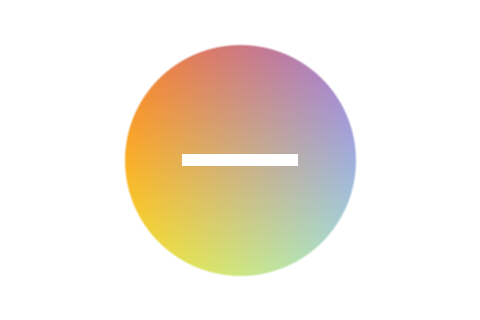
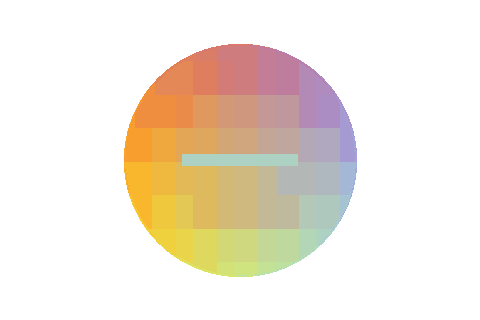
PNG stores an opacity value for every pixel, so an edge can fade gradually from solid to invisible — which is why a PNG logo sits cleanly on any background. The GIF format can mark one palette entry as transparent, on or off with nothing in between, and the encoder on this page writes no such entry. Every pixel in the GIF you download is opaque.
So the see-through areas are filled rather than reduced. Before the palette is computed, they are painted with the background colour — white unless you choose another with the control above — and a logo that used to float arrives on a solid rectangle. Choose the colour it will sit on and the result still looks right; if it has to sit on a background you do not control, keep the PNG or use WebP, which stores the gradual kind.
This surprises people, because GIF feels like an old, small format. PNG uses a more modern compressor and is generally better at the same picture, so converting to GIF often produces a larger file rather than a smaller one — occasionally much larger, if the image has many colours that the palette has to work hard to approximate.
That is worth knowing because it removes one of the usual reasons for converting. GIF is the right answer when something downstream accepts nothing else: an older forum, an e-mail template, a piece of industrial software, a system last updated in 2009. It is not the right answer for making a file smaller — WebP is, and it keeps every colour.
The colour reduction and the GIF encoding both run in your browser, using code the page downloaded. Your image is not sent anywhere, there is no queue, and no account is involved. You can confirm it by opening the network tab of your developer tools and watching nothing carrying the file go out.
This also means the only limits are the two the free tier sets: a hundred files in one drop, and 100 MB per file. Convert one image or a hundred; drop them all at once and take the results as a ZIP. There is no daily count, because the page costs us bandwidth and the conversion costs us nothing.
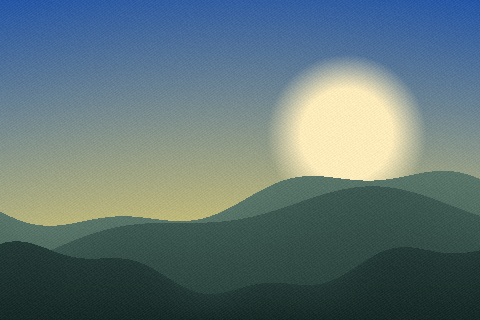
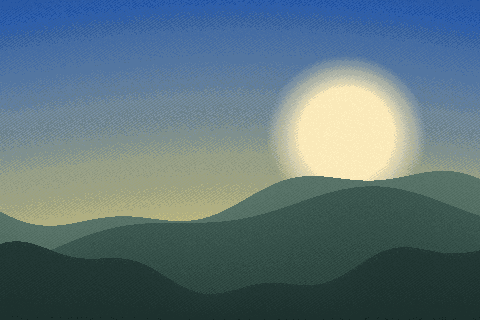
When the palette cannot hold what the image needs, there are two ways to fail. Round every pixel to the nearest surviving colour and you get clean bands. Scatter pixels of two neighbouring colours so the eye blends them, and the bands soften into a fine speckle.
Neither is better in general. On a diagram the rounding is invisible, because there was nothing to round. On a photograph the speckle usually reads as less wrong than stripes, but it also compresses worse, so a dithered GIF is the larger file. The two artefacts are the same lost information wearing different clothes.
There is one case, and it is the case GIF was built for: a small image made of a few flat colours with hard edges. A 32-pixel icon in four colours, a simple diagram, a black-and-white mark. Here the palette is not a limitation at all — the image never had more than a handful of colours — and the compression finds exactly the runs of identical pixels it was designed to collapse.
Even then PNG is usually within a few per cent and often ahead. The honest summary is that GIF is not smaller than PNG for anything; it is merely not much larger for the images it was made for.
PNG can carry a colour profile, a gamma value and text chunks. GIF carries a palette and very little else. Anything the PNG knew about how its colours should be interpreted is dropped, which is one more reason a photograph can look slightly off afterwards rather than merely banded.
Layers, if you are exporting from a design tool, were never in the PNG either. Both formats are flat pictures, and whatever structure existed lives only in the file you exported from.
Drop up to a hundred at once, each file under 100 MB, and take the results as a ZIP. Because nothing is uploaded there is no queue, no account and no daily allowance.
The one thing worth watching is that colour reduction is the slowest step on this page. Each image has its palette computed individually, so a hundred large PNGs take noticeably longer than a hundred small ones. Nothing fails — it simply takes a moment.
| PNG | GIF | |
|---|---|---|
| Full name | Portable Network Graphics | Graphics Interchange Format |
| File extension | .png | .gif |
| Media type | image/png | image/gif |
| Compression | Lossless — nothing is discarded | Lossless — nothing is discarded |
| First published | 1996 | 1987 |
| Published by | PNG Development Group | CompuServe |
| Specification | ISO/IEC 15948 | GIF89a |
| Licensing | Open standard | Open standard |
| Standing today | Current | Legacy, still read everywhere |
| Bit depth | 16 | 8 |
| Colour it can describe | RGB, greyscale, indexed palette | indexed palette |
| Largest image | 2,147,483,647 px per side | 65,535 px per side |
| Opens in a browser | Every browser | Every browser |
| Considered instead | WebP, SVG, JXL | WebP, MP4 |
GIF has no alpha channel. A transparent PNG comes out with those areas filled in — white unless something else is set — and no setting in GIF brings the transparency back.
GIF stores at most 256 colours per frame. A photograph converted into one is reduced to a palette, which is what makes the sky look stepped rather than smooth — it is the format, not a quality setting.
PNG carries up to 16 bits per channel and GIF stores 8. The extra precision is what survives heavy correction without banding, so the conversion is best made after the editing rather than before it.
Adobe Photoshop and GIMP read both PNG and GIF, so there is a way to check the result against the original without a second tool.
PNG is PNG Development Group's format, published in 1996. It records 16 bits per channel.
GIF comes from CompuServe and dates from 1987, specified as GIF89a. GIMP, Adobe Photoshop and ImageMagick all read it.
No, and nothing can from a single PNG. An animation needs several frames and one image is one frame — a converter that claimed otherwise would be inventing motion that is not in your file. What you get here is a still GIF: the same picture, in the GIF format. If you want animation you need either a video (convert an MP4 to WebM for the web) or software that assembles several images into frames.
Because GIF can only hold 256 colours in one image, and a PNG can hold sixteen million. Everything else has to be approximated by the nearest of the 256 that survive, which is invisible on a logo or a diagram and very visible on a photograph — skies and skin tones break into bands. If the image is a photograph, PNG, JPG or WebP will all look better.
No. The GIF format can carry a one-bit mask, but the encoder here writes no transparent index — the see-through areas are filled with the background colour before the palette is chosen, white unless you pick another with the control above. A PNG cut-out therefore arrives on a solid rectangle rather than with a jagged edge. PNG and WebP both keep the gradual kind of transparency.
Usually not. GIF is an old format and PNG generally compresses the same picture better, so people are often surprised to find the file grew. GIF is worth converting to because something demands the format, not because it saves space.
No. The colour reduction and the GIF encoding both run inside your browser, so the file never leaves your device. There is no account and no queue, and no daily count, because a conversion costs us nothing — a drop takes up to a hundred files, each up to 100 MB.
This page converts one into the other. If you are choosing rather than converting, PNG vs GIF answers which to use, for what, and what each is bad at.
The claims this page makes about PNG and GIF are checkable, and these are the documents that settle them.